Cambridge vs International Baccalaureate: A Parent's Guide
Cambridge vs International Baccalaureate explained for Indian families. Compare curriculum, cost, university recognition, and which board fits your child best.
You're at the school open house, and the admissions team has placed two glossy brochures in front of you. One says Cambridge, the other says International Baccalaureate. Both look premium, both promise global doors, and both can leave Indian parents more confused than reassured. The mistake most families make is treating this as a philosophy debate. It isn't. It's a practical decision about where your child can study, how they'll be assessed, what it will cost, and which university routes stay open.
| Factor | Cambridge | International Baccalaureate |
|---|---|---|
| Subject style | Deeper specialisation after IGCSE | Broad six-subject structure |
| Assessment feel | Stronger focus on final exams and subject mastery | Mix of internal assessments, essays, and final exams |
| Flexibility | Easier to drop weak subjects and narrow focus | More structured, with six subjects plus core requirements |
| Fit for Indian specialists | Strong for engineering and medicine aspirants | Strong for students who can handle breadth and consistency |
| City access | Far more widely available in India | Usually clustered in fewer metros |
| Budgeting | Subject fees can make the bill less predictable | Total package is often easier to think about, but still expensive |
If you want the blunt counsellor's answer, here it is. Cambridge is usually the safer choice for students who already know their direction and want control. IB is usually better for students who can manage breadth, writing, and steady effort across two years. The brochures matter less than your child's actual profile, the family's city, and the university destination you're really aiming for.
Table of Contents
- The Practical Choice Behind the Cambridge vs International Baccalaureate Question
- What families are choosing
- The Indian trade-offs that matter
- How Each System Is Built
- Cambridge starts narrow, then gets narrower by design
- IB stays broad and makes breadth a core requirement
- What Assessment Really Feels Like for a Class 10 or 12 Student
- Cambridge gives more control over the exam cycle
- IB asks for consistency across the whole stretch
- Access and Availability Across Indian Cities
- Why the city you live in changes the board you choose
- The practical access question parents should ask
- The True Cost Stack Indian Families Should Budget For
- The four layers that shape the bill
- Budget like a parent, not like a brochure reader
- University Pathways from Cambridge and IB in India and Abroad
- How Cambridge fits Indian admission realities
- Where IB helps, and where it can block options
- Which Board Fits Which Student
- Four common student profiles
The Practical Choice Behind the Cambridge vs International Baccalaureate Question
A Class 9 parent does not walk into an open house thinking about curriculum theory. They leave with two glossy pitches in hand, one from a school that offers Cambridge IGCSE and A Levels, the other from a school selling the IB Diploma as the more “global” route. The better question is far less glamorous, and far more useful.
What families are choosing
Cambridge is built for subject depth. A student can specialise earlier, move into three or four A Level subjects, and stay focused on what matters for engineering, medicine, economics, or a similar track. That is why so many Indian families with a clear career target choose it. They want fewer moving parts and tighter control over the subjects that count.
IB asks for the opposite discipline. It demands breadth, regular writing, and comfort with six subjects plus the core components. For students who enjoy connecting ideas and can keep pace with coursework across the year, that structure works well. For students who crack under constant internal deadlines, it becomes exhausting.
Practical rule: if your child already knows they want a narrow academic lane, Cambridge usually fits better. If they are genuinely undecided and can handle sustained workload, IB keeps more doors open.
The Indian trade-offs that matter
Indian families should judge this on three things, not on brand image. First, subject specialisation depth, because a future engineer does not need six subjects in the same way a liberal arts applicant does. Second, exposure to internal coursework, because some children do brilliantly in exam prep but struggle with ongoing project pressure. Third, retake control, because Cambridge gives families more room to manage weak papers and subject choices in a more modular way.
That last point matters in Indian homes. Parents often want a system that still gives the child a chance to recover after one bad term or one bad paper. Cambridge is more forgiving in that sense. IB is cleaner as a package, but less forgiving if one part slips.
The brochure language is secondary. Match the board to the child's academic profile and the university destination first. Then judge the school, not the slogan.
How Each System Is Built
Cambridge starts narrow, then gets narrower by design
Cambridge feels familiar to many Indian families because it follows a progression similar to Indian schooling. IGCSE comes first, then A Levels. At the upper stage, students usually take three or four subjects, not six. That is the design. By Classes 11 and 12, Cambridge expects a student to choose early, commit, and study in depth.
For a science-heavy student, that means Mathematics, Physics, and Chemistry without the padding of extra subjects just to fill time. It suits students who already know their direction. It also keeps the workload more contained, which matters in Indian homes where coaching, commute, and homework already crowd the day.
IB stays broad and makes breadth a core requirement
The IB Diploma Programme works differently. It requires six subject groups, with three Higher Level and three Standard Level subjects. On top of that sit Theory of Knowledge, the Extended Essay, and CAS. The structure is deliberate. IB keeps students broad, reflective, and used to crossing subject boundaries.
For science-focused Indian students, that can feel restrictive. You do not only choose the subjects you like. You also keep a second language alive, and you may need to make room for a Group 6 arts or elective slot. For a child who wants to put most of the energy into Physics, Chemistry, and Mathematics, that breadth can feel like a drain on focus.
| Feature | Cambridge (IGCSE + A Level) | International Baccalaureate (IBDP) |
|---|---|---|
| Subject structure | Smaller set, deeper study | Six subject groups, broader study |
| Upper secondary focus | Specialisation | Breadth and balance |
| Language requirement | School-dependent | Built into the diploma structure |
| Extra core work | No fixed TOK, EE, CAS requirement | TOK, Extended Essay, CAS required |
| Fit for narrow goals | Strong | Mixed, because of breadth obligations |
The structural difference is the point. Cambridge lets a child shape the map. IB sets the wider map from the start. For Indian families, that choice affects more than classroom style. It affects subject depth, exam planning, and how easily a student keeps options open for engineering, medicine, or overseas admissions.
What Assessment Really Feels Like for a Class 10 or 12 Student
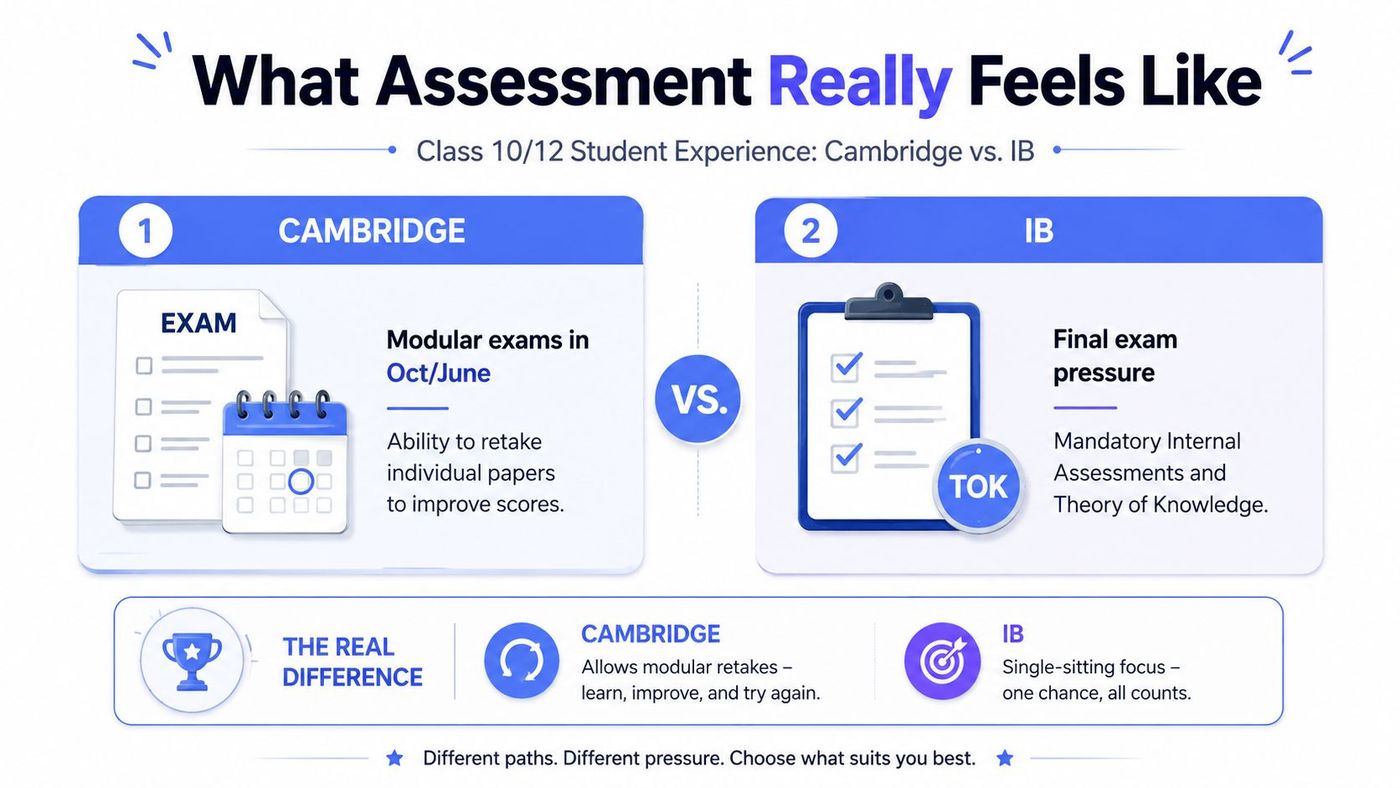
A Class 10 or 12 student does not experience a board through policy language. They experience it through deadlines, revision pressure, and the way teachers mark their work. Cambridge feels more like the Indian exam system many families already understand. IB feels more like a long-running project where the work never fully stops.
Cambridge gives more control over the exam cycle
Cambridge students deal with modular exams and can often focus on individual papers. The structure lets schools and students prepare in a way that feels familiar to Indian families used to terminal exams. A student who has a weak paper in one subject is not automatically sunk across the whole diploma. That matters more than most brochures admit.
Predicted grades also play a practical role in the Cambridge journey. Universities understand them clearly, and schools use them as part of the application picture. Students who revise well for structured papers, past papers, and timed writing often find Cambridge more humane than it first looks. They know what is coming, and they can train for it.
IB asks for consistency across the whole stretch
IB students live with a different pressure. Their final result depends on terminal exams, internal assessments, the Extended Essay, and TOK. A student can't just be brilliant in one paper and coast. Every subject counts towards the final diploma, and the internal work keeps running through the two years.
That is why IB rewards students who can plan, write, and stay consistent. It punishes those who work in bursts. Indian parents who have seen children do well in school tests but fall apart when projects stack up usually know exactly what I mean.
The child who likes deadlines, feedback, and repeated revision often settles more comfortably into Cambridge. The child who can hold a long task in memory for months usually handles IB better.
A useful revision tool can help Cambridge students build that exam discipline, especially in IGCSE years, and an AI-powered IGCSE revision tool can be worth a look if your child needs structured practice rather than vague motivation. For families still deciding subject combinations, the logic behind those choices also connects well with this subject-combination guide.
| Assessment Feature | Cambridge A Level | IB Diploma |
|---|---|---|
| Main pressure point | Final papers and paper-by-paper performance | Continuous workload plus final exams |
| Retake control | More flexible | Much less forgiving |
| Coursework burden | Subject-dependent | Built into the programme |
| Weak subject impact | Can be isolated more easily | A weak subject affects the whole diploma |
| Student type rewarded | Exam technique, subject mastery | Consistency, organisation, writing stamina |
Access and Availability Across Indian Cities
The first thing many families discover is not curriculum quality, but school supply. Cambridge has the wider footprint in India, and that changes everything. A 2025 report in The Indian Express said Cambridge Assessment International Education had surpassed 1,000 schools in South Asia, with over 800 in India alone, while IB schools in India grew from 183 in 2019 to over 255 in 2025. The same report said Cambridge schools in India rose from 461 in 2019–20 to over 800 by 2024–25.
Why the city you live in changes the board you choose
That supply gap affects real life. In metros like Delhi NCR, Mumbai, Bengaluru, Hyderabad, Chennai, Pune, and Kolkata, both boards may exist, but Cambridge is usually easier to find. In secondary cities, Cambridge is often the only realistic international-board option families can access without a punishing commute.
The issue is not just school count. It is commute time, waitlist pressure, and whether your child can secure a seat in Class 9 or 11. Families often begin by comparing pedagogy and end up choosing based on the nearest credible campus. That's not a failure of judgement. It's how school access works in India.
The practical access question parents should ask
IB often sits inside a smaller cluster of urban private schools, and some campuses offer only the Diploma stage rather than a full pathway. That matters if your child is entering late. A family in Kochi or Indore may find Cambridge far more reachable than IB. A family in Bengaluru or Mumbai may find both, but with very different admissions odds and transport burdens.
The board choice is often made before the pedagogy debate starts. If the school isn't reachable, it isn't a serious option.
A better way to think about this is simple. Ask which board is available in your city, what the commute looks like, and whether the school offers the stage your child needs. A board on paper means nothing if the child will spend two hours a day getting to it.
| City | Cambridge Schools (approx.) | IB World Schools (approx.) | Typical Waitlist |
|---|---|---|---|
| Delhi NCR | High | Medium | Strong in top campuses |
| Mumbai | High | Medium | Strong in premium schools |
| Bengaluru | High | Medium | Strong in popular zones |
| Hyderabad | High | Medium | Moderate to strong |
| Chennai | High | Low to medium | Moderate |
| Pune | High | Low to medium | Moderate |
| Kolkata | Moderate | Low | Varies by school |
| Lucknow | Lower | Very limited | Narrow and selective |
| Indore | Lower | Very limited | Narrow and selective |
| Kochi | Lower | Very limited | Narrow and selective |
| Coimbatore | Lower | Very limited | Narrow and selective |
| Chandigarh | Lower | Very limited | Narrow and selective |
The True Cost Stack Indian Families Should Budget For
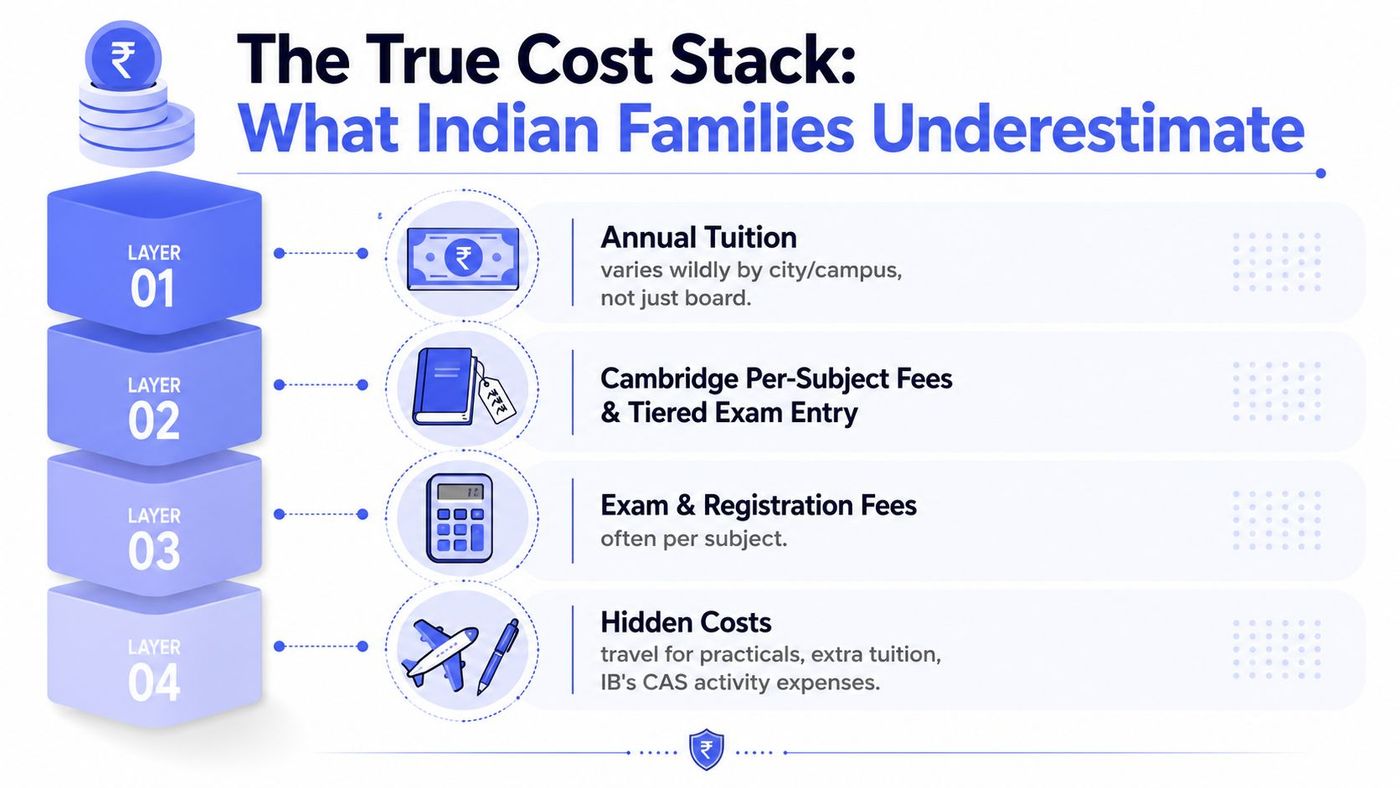
Most fee brochures tell half the story. They show tuition, maybe transport, and sometimes a few activity charges. They rarely show the full outflow. For Indian families comparing Cambridge vs International Baccalaureate, the budget has four layers.
The four layers that shape the bill
First comes annual tuition, and that can vary sharply by city and campus. A premium metro school will not cost like a smaller-city campus, even if both follow the same board. Second comes Cambridge's per-subject exam fees, especially in IGCSE and A Levels, where subject count directly drives cost. Cambridge's India fee schedule shows per-subject exam fees for IGCSE and A Levels, with IGCSE listed at 72.90 per subject and A Level at 117.75 per subject.
Third comes the IB cost structure, which is usually discussed as a bundle. Families should still ask about registration, subject administration, and the school's handling of EE, TOK, and CAS. Fourth are the hidden extras that catch families off guard, such as textbooks, practical materials, travel for assessments, and university application support.
Budget like a parent, not like a brochure reader
For Class 11 to 12 in Indian metros, both systems can live in the ₹3.5–₹12 lakh annual range according to a comparison source, and that same source notes IB is usually 15–20% more expensive than Cambridge at equivalent-tier schools. The exact number is less important than the habit: don't compare tuition alone. Compare the full school-year outflow.
Use this checklist before you sign anything.
- Ask for exam fee breakdowns: Get the subject-wise Cambridge entry charges or the IB fee inclusions in writing.
- Check transport separately: A cheaper school can become expensive if commute time is brutal.
- Confirm practical and lab costs: Science students often pay more than the brochure suggests.
- Ask about application support: University counselling, predicted grades, and document handling can add to the bill.
- Test the total, not the sticker price: Add tuition, exams, books, transport, and extras before you commit.
If a school's brochure looks neat but the answers on fees feel vague, treat that as a warning sign. The most honest school is the one that tells you the likely total outlay before admissions day, not after the fee receipt lands.
University Pathways from Cambridge and IB in India and Abroad
Indian families rarely choose a board for the sake of a board. They choose it because they want a child who can still enter Indian engineering and medical routes, or keep the option of UK, US, Singapore, Australia, or Gulf universities open. That is where Cambridge and IB diverge in practice, not just in theory.
How Cambridge fits Indian admission realities
Cambridge's biggest advantage is subject flexibility. A student targeting engineering can go hard on Maths, Physics, and Chemistry without being trapped in a broad package. That lines up well with JEE preparation and with the kind of subject-heavy entry requirements many Indian families already understand. Cambridge's India recognition page says Cambridge A Levels are formally recognised as equivalent to Grade 12, NCrF Level 4.0, and Cambridge IGCSE is recognised as equivalent to Grade 10, NCrF Level 3.0 in India.
That equivalency matters when families want a clean academic fallback. It makes Cambridge's terminal credentials easier to map against Indian benchmarks. For overseas applications, Cambridge also works well because universities understand the A Level pattern and the subject specialisation it represents.
Where IB helps, and where it can block options
IB's full diploma is excellent for students who want a structured, broad academic profile. It suits overseas applications well, especially where research, essays, and overall evaluation matter. But Indian families need to be careful. Subject choice in IB can clash with JEE or NEET preparation if the student spreads too thin, and a poor combination can subtly close off certain Indian quotas or programme requirements later.
That is why the comparison should not be “Which board is globally recognised?” Both are. The better question is, “Which one fits the route my child may use?” If your child may shift back into Indian entrance exams, Cambridge's narrower structure often offers a cleaner fallback. If they are focused on overseas study and can sustain the diploma's breadth, IB is a strong fit.
For families trying to map these routes into longer planning, this future-planning guide is the kind of thinking that should happen before Class 11 starts, not after.
| Pathway | Cambridge (IGCSE + A Levels) | IB Diploma |
|---|---|---|
| Indian engineering routes | Strong subject fit | Possible, but breadth can dilute focus |
| Indian medicine routes | Good for science specialisation | Possible, but needs careful subject planning |
| UK university entry | Very direct | Strong and widely accepted |
| US university entry | Strong | Strong, especially for holistic review |
| Research-heavy profiles | Good if school support is strong | Naturally aligned with EE and TOK |
| Risk of closing options | Lower if subject choices are sensible | Higher if subject mix is too narrow or misaligned |
Which Board Fits Which Student
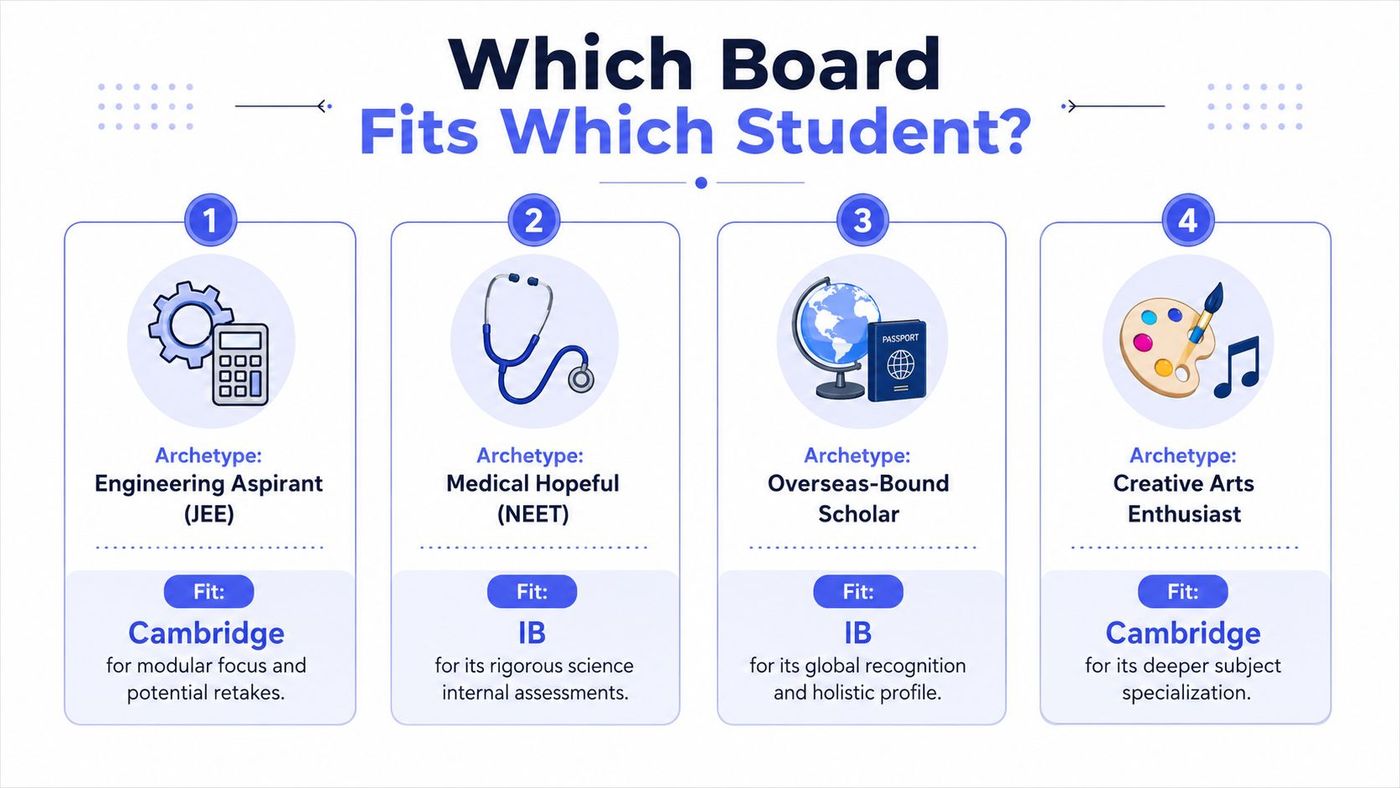
Start with the child, not the board. Families usually do the opposite, then spend the next two years managing avoidable stress. The right choice depends on how your child studies, which city you live in, and what comes after school.
For Indian families, the issue is not prestige. It is whether the board fits the route your child is most likely to take.
Four common student profiles
Engineering aspirant, JEE track. Cambridge is the cleaner default. The subject structure stays tight, the science load is sharper, and the student can protect the academic core that matters for entrance prep. IB can work, but only for a highly disciplined student in a school that knows how to manage the workload.
Medical hopeful, NEET track. Cambridge again has the edge for most families. A science-heavy path with controlled subject depth is easier to keep aligned with Indian entrance preparation. IB suits a student who wants a broader academic profile, but that breadth can become a drag if it pulls attention away from exam prep.
Overseas-bound scholar. IB often fits this student well, especially for universities that value essays, research, and steady performance across subjects. Cambridge still works very well for the UK and other global destinations, but IB suits students who can handle long-form, cumulative assessment without losing pace.
Creative arts enthusiast or late bloomer with one weak subject. Cambridge is usually the safer choice. A student can narrow the subject set and avoid carrying dead weight. That matters if one subject keeps pulling grades down. IB's breadth can steady a confused student early on, but it can also become a trap if a weak subject stays weak.
Board choice also depends on temperament. If your child wants clear exam targets and dislikes constant coursework, Cambridge is the better fit. If your child can sustain essays, discussion, and steady effort across multiple strands, IB suits that style better. For families still checking aptitude against interest, these psychometric assessment examples show the kind of structured thinking that helps before you commit to a board.
Choose the board that protects your child's strongest habits, not the one that sounds better in a WhatsApp group.
Here is the simplest verdict. Cambridge is the better default for specialist students, Indian entrance-exam aspirants, and families who want tighter control. IB is better for broad, resilient students who can carry a heavier workload and want a globally styled academic profile. If your city has limited IB access, that may settle the decision on its own. For a deeper look at IB depth and breadth trade-offs, see this analysis from Queens Online School.
| Pathway | Cambridge (IGCSE + A Levels) | IB Diploma |
|---|---|---|
| Indian engineering routes | Strong subject fit | Possible, but breadth can dilute focus |
| Indian medicine routes | Good for science specialisation | Possible, but needs careful subject planning |
| UK university entry | Very direct | Strong and widely accepted |
| US university entry | Strong | Strong, especially for admissions that value well-rounded profiles |
| Research-heavy profiles | Good if school support is strong | Naturally aligned with EE and TOK |
| Risk of closing options | Lower if subject choices are sensible | Higher if subject mix is too narrow or misaligned |