Subject Combination of 10th: Smart Choices After Class 10
Subject Combination of 10th. Explore common subject combinations after Class 10 in India, how each shapes future streams and careers, plus board-specific rules
Your child is sitting at the dining table with the Class 10 result sheet open, and the conversation has already gone sideways. One parent is saying, “Take Science with Mathematics, engineer bano,” while the student keeps asking about Psychology, Economics, or maybe Commerce with Maths because that feels more natural. That argument is common in Indian homes, but it's the wrong way to handle a subject combination of 10th.
The issue isn't prestige. It's eligibility, workload, and family alignment. Once you understand what boards allow, what each combination offers, and where the hard trade-offs sit, you can stop treating this as a fight and start treating it like a decision. If you're also trying to calm a parent who's already convinced, a structured parent-facing explanation helps, and you can keep one open while you decide by looking at this parent guide.
Table of Contents
- The Class 10 Decision Moment Every Indian Family Faces
- What parents usually miss
- How Indian Boards Structure Subject Combinations
- The board sets the architecture
- The Main Stream Pathways and What They Unlock
- Science with Mathematics and Science with Biology
- Commerce with Mathematics and Commerce without Mathematics
- Humanities and Arts combinations
- What the National Stream Data Shows Families
- What that means in plain English
- CBSE and State Board Electives You Should Know About
- CBSE is more flexible than the old three-stream model
- When Parents Want Science and the Student Wants Something Else
- How a counsellor should read the evidence
- A Practical Framework for Choosing the Right Combination
- Use this sequence
- A small worked example
- Common Mistakes and One Habit That Gets It Right
The Class 10 Decision Moment Every Indian Family Faces
A Class 10 student doesn't need another lecture about “big dreams”. They need a decision that fits their marks, stamina, interests, and the family's reality. The problem is that most homes begin with a conclusion and work backwards, usually from whatever stream a neighbour's child took or whatever career one relative keeps praising.
That's why stream choice after Class 10 turns into an emotional fight. One side speaks in certainty, the other in hesitation. The student may already know they dislike one subject cluster, but they're told to “adjust” because everyone else is doing it.
What parents usually miss
Parents often treat stream selection as a badge of seriousness. Students experience it as a test of whether anyone is listening to them. Those are not the same thing.
The better frame is simple. Class 10 subject choice is about preserving or narrowing future options on purpose, not proving who is more ambitious. A student who chooses a combination badly may spend two years fighting the syllabus instead of building marks, confidence, and exam readiness. A student who chooses well gets room to grow into Class 11 instead of collapsing under it.
Practical rule: don't ask, “Which stream is safest?” Ask, “Which combination matches this child's current pattern and still keeps enough doors open?”
This guide is built to replace the dinner-table deadlock with a decision method that families can use. It doesn't ask parents to surrender their concerns. It asks them to put those concerns into a structure, and that changes the conversation immediately.
How Indian Boards Structure Subject Combinations
Class 10 choices in India are not a free-form menu. Boards set the frame first, then students choose inside it. Families often argue as if a child can mix any subjects they like, but boards rarely work that way.
The board sets the architecture
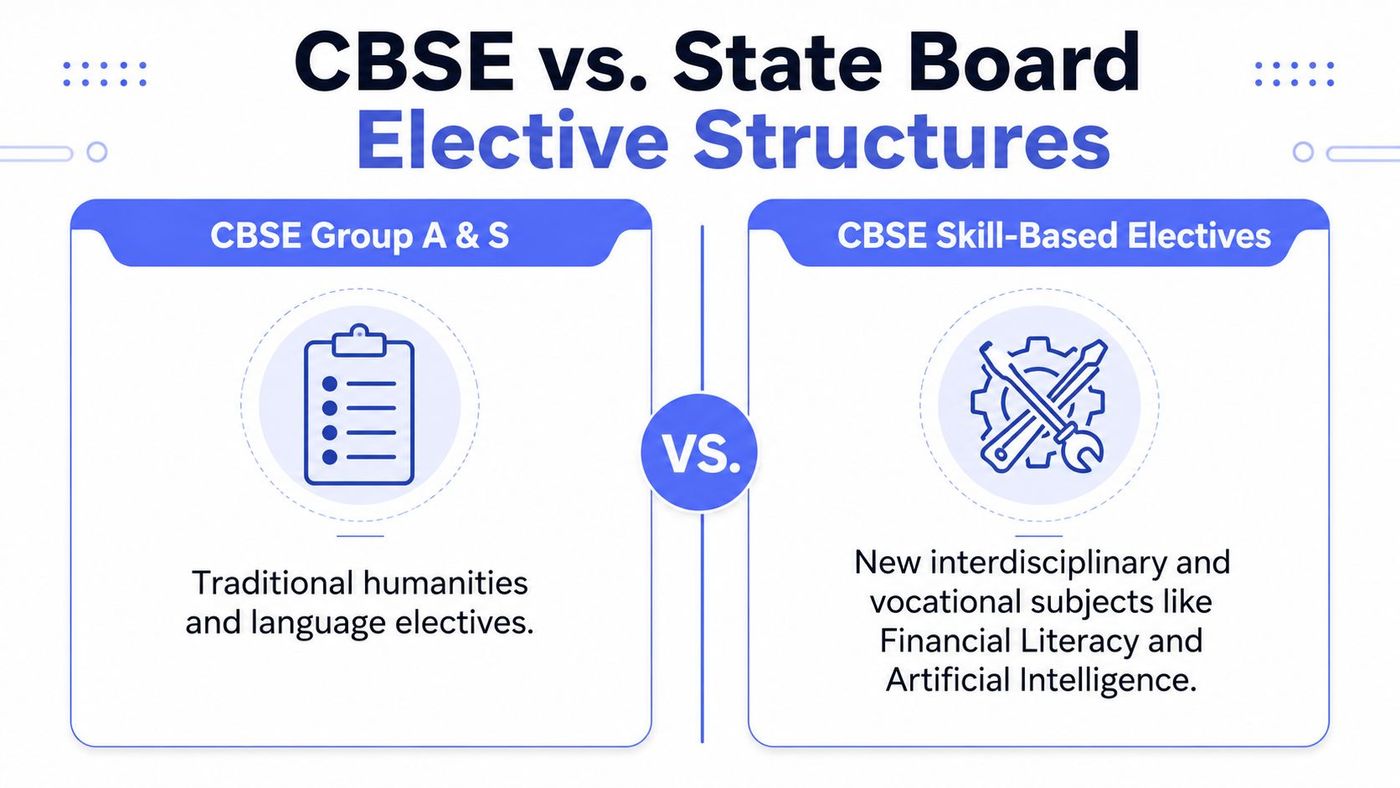
CBSE's senior secondary structure shows the logic clearly. Subject combinations are built from compulsory language papers plus academic electives or skill subjects, with Subject 3 to 5 chosen from Group A or Group S, and an optional sixth subject from any unused group, according to the CBSE curriculum document for 2025-26 (CBSE senior secondary curriculum). The board is not asking, “What do you fancy?” It is saying, “Choose from these sanctioned combinations.”
Schools publish combinations such as Science with Mathematics or Computer Science, Science with Biology, Commerce with or without Mathematics, and Humanities with Economics or Political Science. Those are not marketing slogans. They are the actual containers the student has to fit into.
Some state boards are stricter. They may require a third language or a regional paper, which cuts flexibility further. So before anyone argues about a stream, they need to understand the subject architecture already in place.
The lesson is blunt. You are not designing a personal curriculum, you are selecting from board-sanctioned combinations that carry different downstream consequences. Once families accept that, they stop fighting over fantasy combinations and start choosing realistically.
The Main Stream Pathways and What They Unlock
The old “Science, Commerce, Arts” label hides the decision. What matters is the subject combination underneath the stream, because that's what shapes future eligibility, preparation load, and admissions comfort.
Science with Mathematics and Science with Biology
Science with Mathematics is the base many families associate with engineering, computer science, quantitative undergraduate routes, and a wide range of STEM options. It keeps the strongest alignment with technical entrance pathways and data-heavy work later. Science with Biology shifts the path towards medicine, life sciences, allied health, and biologically oriented undergraduate study. The important thing is not talent mythology. It's that each version preserves a different kind of future.
Key point: Mathematics keeps optionality for more quantitative routes. Biology keeps optionality for medical and life-science routes.
Commerce with Mathematics and Commerce without Mathematics
Commerce with Mathematics is the smarter version if the student may later want finance, economics, analytics, BBA, or professional routes that reward numerical comfort. Commerce without Mathematics is not a weak option. It narrows the future in a sensible way for students who are stronger in accounts, business studies, or law-oriented tracks and who do not want a maths-heavy Class 11 load.
Humanities and Arts combinations
Humanities has stopped being the “last resort” stream in any serious counselling room. A combination built around Economics, Political Science, Geography, Psychology, or History can suit students aiming for UPSC preparation, journalism, design, liberal arts, law, public policy, and related degrees. The strength here is flexibility of thought, reading load, and conceptual expression.
| Combination | Core Subjects | Opens | Closes or Narrows |
|---|---|---|---|
| Science with Mathematics | Physics, Chemistry, Mathematics, and related electives | Engineering, computer science, quantitative routes | Narrows medical pathways if Biology is missing |
| Science with Biology | Physics, Chemistry, Biology, and related electives | Medicine, life sciences, allied health | Narrows engineering-style pathways that depend on Mathematics |
| Commerce with Mathematics | Accounts, Business Studies, Economics, Mathematics | Finance, economics, analytics, BBA, CA-adjacent routes | Narrows lighter commerce setups |
| Commerce without Mathematics | Accounts, Business Studies, Economics, language subjects | BCom, management, law, commerce degrees | Narrows maths-heavy routes |
| Humanities | Economics, Political Science, Psychology, Geography, etc. | UPSC, journalism, law, design, liberal arts | Narrows technical and medical routes |
The question is not “Which stream is superior?” It's “Which set of doors do you want to keep open, and which doors are you fine closing?” That's the only honest way to choose.
What the National Stream Data Shows Families
The national data cuts through a lot of prestige talk. Analysts at the Ministry of Education, using Class 10 to 12 board data, found that Science and Arts were the most chosen streams in India over the last decade, both rising from about 31% of students in 2012 to above 40% in 2022. In absolute numbers, Arts moved from 30.9 lakh students in 2012 to 40 lakh in 2022, while Science rose from 30.7 lakh to 42 lakh in the same period (DNA report on stream popularity).
What that means in plain English
This is a major school-system sorting point, not a side decision. Families should treat stream choice as a real fork in workload, eligibility, and long-term options.
Commerce stayed comparatively flat, moving only from 13.7 lakh students in 2012 to 14.4 lakh in 2022, or roughly 14% of students. That does not make Commerce weak. It shows a smaller, steadier pathway with a different competition profile.
| Stream | Share of Class 11 Enrolment | Typical Competition Density | Coaching Ecosystem |
|---|---|---|---|
| Science | Very high | Heavy | Large and intensely crowded |
| Arts or Humanities | Very high | Heavy in top schools and colleges | Broad, but less standardised |
| Commerce | Smaller and steadier | Moderate to high | Strong, especially for accounts and maths-linked routes |
Parents should read this correctly. Science and Arts attract the largest numbers, so the pressure inside those tracks is intense. Commerce remains more contained, but it is still serious if the student wants accounts, economics, finance, or maths-linked routes.
The practical takeaway is simple. Choose for workload fit and downstream eligibility, not for social prestige. A student who can handle the subject mix will usually do better than one pushed into a “respectable” stream and left struggling for two years.
CBSE and State Board Electives You Should Know About
A lot of families still think the choice is only between a few old-fashioned subjects. That's outdated. Boards have widened the menu, but they haven't removed the rules.
CBSE is more flexible than the old three-stream model
CBSE now allows combinations built from the compulsory language subjects plus elective or skill subjects, and schools commonly sanction combinations around Artificial Intelligence, Computer Applications, Information Technology, Psychology, Home Science, Marketing, and other options within the board's grouping structure. Some of these sit under skill education, which means universities may not count them the same way they count a core academic subject, so families need to check the exact status before locking anything in.
Practical rule: an elective that looks attractive on paper can still be a bad fit if the Class 11 admission brochure treats it differently.
State boards have also broadened the options. West Bengal's higher secondary framework includes modern subjects such as Cyber Security and Artificial Intelligence and Data Science with practical components, while other state systems offer vocational clusters and applied combinations. The result is more choice, but also more confusion.
Families need a counsellor or a school office that can read the fine print, not just the brochure. If you want a structured place to verify subject-to-stream fit and compare options, StudyHQ's stream-selection resources are designed for Indian students and families, and you can access them through its resource library.
The deciding habit is boring, but essential. Read the school's sanctioned combination list, then read the Class 11 admission prospectus, then verify whether the elective is treated as a supporting subject or a core one. Skipping that step is how families end up with a combination that looks modern but blocks the next move.
When Parents Want Science and the Student Wants Something Else
A familiar case lands in the counselling room every year. A student has stronger marks in English, History, and Economics than in Physics and Mathematics. The parents still insist on Science with Maths, usually because they believe it preserves the IIT-JEE route, or because somebody in the apartment complex says Science is the only serious choice.
How a counsellor should read the evidence
The first thing I check is not the dream. It's the pattern. If the student has shown steadier performance in reading-heavy and analytical humanities subjects across multiple tests, that is not a random blip. It's a signal.
The second thing is interest. If the student already talks fluently about policy, society, writing, or current affairs, then forcing a Science heavy load usually creates a long, miserable slog. The family may still keep the door open for competitive seriousness by choosing a Humanities combination with Economics. That isn't surrender. It's a proper academic fit.
The third thing is honesty about competition. A real JEE attempt requires a serious cohort around the student, not just parental hope. If the child is already weak in Physics and uneasy in Mathematics, pushing them into Science because it sounds “safe” is a gamble dressed up as security.
The right stream is the one the student can actually study well in every week, not the one that sounds impressive at wedding conversations.
A one-month decision window works better than an emotional one-night verdict. During that month, the family can agree on review points, ask the school for subject breakdowns, and let the student speak in specifics rather than slogans. When the conversation is evidence-led, the result often becomes obvious.
A Practical Framework for Choosing the Right Combination
A good subject combination of 10th decision does not come from one test score. It comes from a layered check, and families who use it stop swinging between fear and fantasy.
Use this sequence
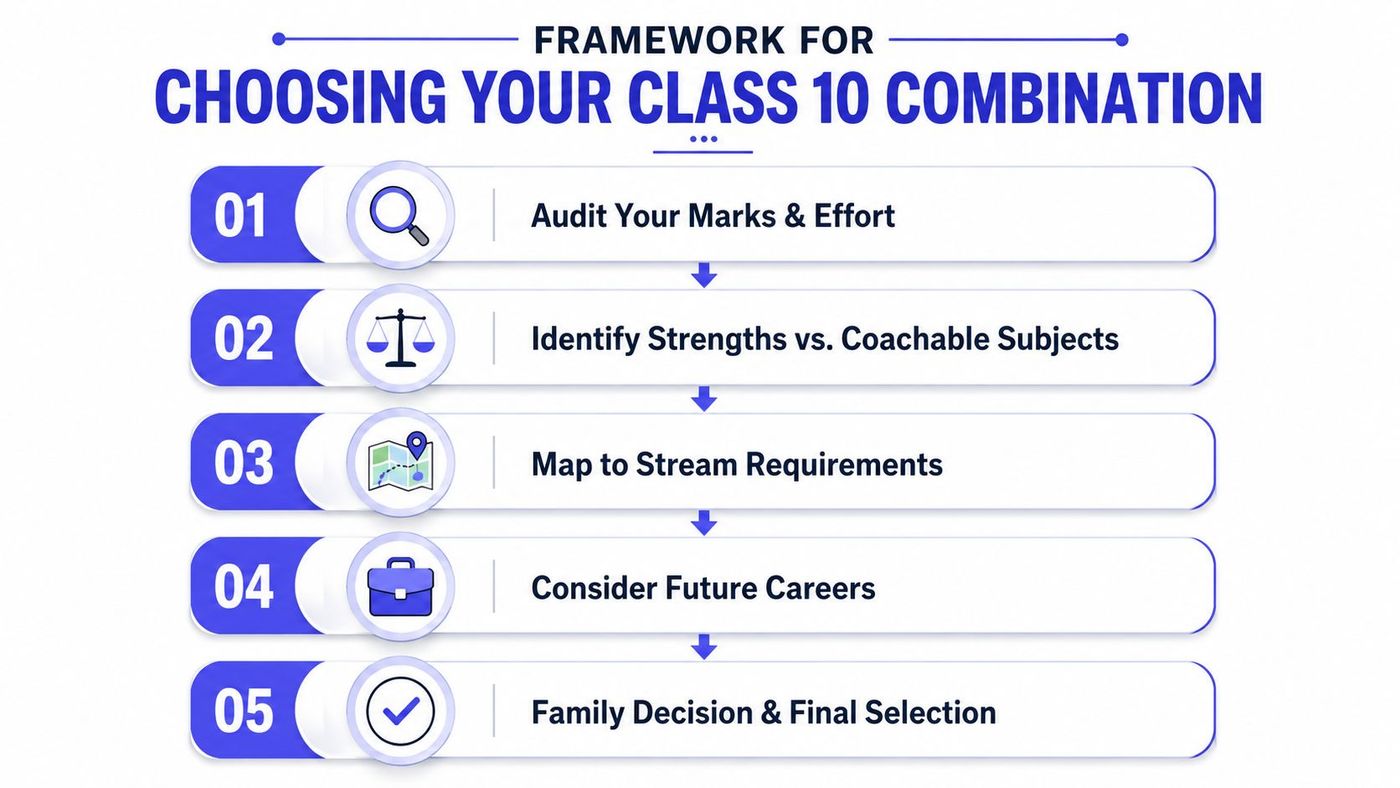
- Audit Class 9 and 10 performance by subject. Do not look only at marks. Look at effort, recovery after bad tests, and how much coaching was needed to hold the score up.
- Shortlist two or three realistic stream families. If the student is strong in Maths but shaky in Physics, pure Science is not the only sensible option. Commerce with Maths may fit better.
- Test each option against four filters. Check workload tolerance, optionality for Class 12, competitive exam eligibility, and family agreement on cost and location.
- Run a short shadow exercise. Read one Class 11 chapter from each shortlisted combination and ask the student which one feels tiring, which one feels manageable, and which one feels inviting.
- Pressure-test the final choice with a counsellor or a trusted school teacher. The point is not approval theatre. It is catching blind spots before admission closes.
A small worked example
A student is strong in Mathematics, average in English, and weak in Physics. Parents want Science because they assume Maths alone is enough. The better move is to rule out pure Science early and examine Commerce with Mathematics. It preserves numerical work, keeps future routes open in finance and economics, and avoids a weak Physics burden that could drag every term down.
If you want a structured way to do this with a human counsellor and a documented roadmap, StudyHQ offers Class 10 stream-selection guidance as part of its Indian career counselling flow. If you want the choice written down, compared properly, and tracked instead of argued over repeatedly, use StudyHQ students guidance as the starting point.
Common Mistakes and One Habit That Gets It Right
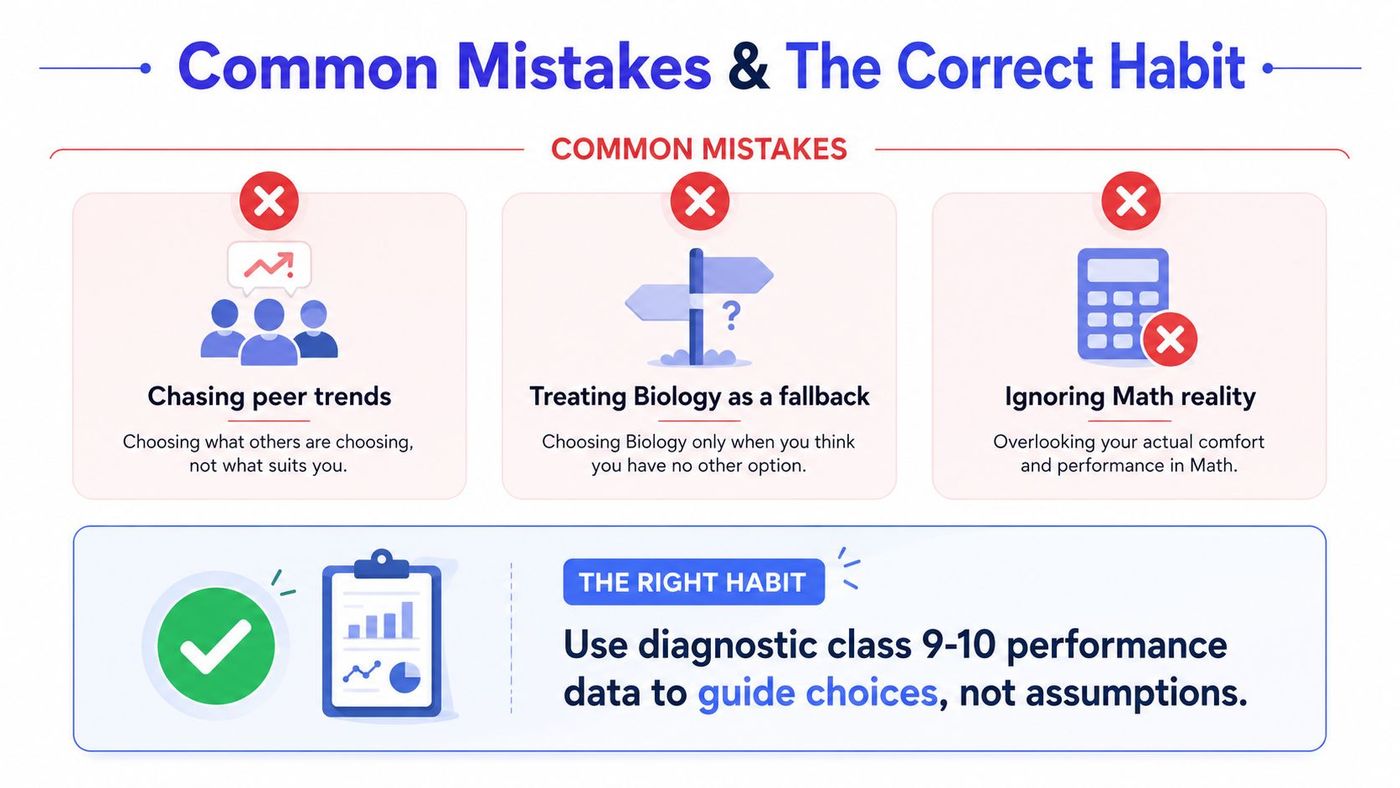
The same mistakes repeat every year. Families chase the neighbour's child into Science without checking diagnostic data. They treat Biology as a fallback when it is the right route for a medical or life-science goal. They dismiss Mathematics too quickly without asking whether the problem is the subject itself or the way it's being taught. They also overreact to one coaching advertisement and let board rank decide stream prestige, which is exactly backwards.
The corrections are plain. Use the student's own performance pattern, not social pressure. Treat Biology and Mathematics as different access keys, not status symbols. Judge stream fit by future workload and eligibility, not by what sounds tougher in conversation.
The one habit that gets this right is a written two-page stream brief signed by both student and parent. It should state the shortlisted combinations, the reason each one is in or out, the exam goals being preserved, and the main risk in each option. Revisit it every quarter until admission closes. That simple document stops the fight from becoming endless and turns the choice into a plan.
If you're still stuck between two combinations, don't keep arguing at the dinner table. StudyHQ can help you compare the trade-offs, document the reasoning, and turn a confusing Class 10 decision into a structured next step. Visit StudyHQ and use its guidance tools to work out the right stream before the admission window tightens.
Published via the Outrank tool