8 Psychometric Assessment Examples for Indian Students
Explore 8 psychometric assessment examples covering cognitive, interest and behavioural tests, with interpretation notes and Indian student applications.
A psychometric result can't name a student's ideal career. It can show patterns in how the student reasons, what kinds of work attract them, and how they tend to approach decisions, pressure, people, or structure. Those are useful signals, but they're not a destiny statement.
The most useful psychometric assessment examples fall into three evidence layers. Cognitive ability tests examine reasoning and problem-solving. Interest assessments identify subjects, activities, and occupational themes that attract a student. Behaviour and personality tools describe preferences, habits, emotional tendencies, or interpersonal styles. A reliable recommendation connects those layers to a concrete question, such as stream selection after Class 10, course validation, study-abroad preparation, or a parent and student discussion.
India's context matters. Language, cultural familiarity, coaching exposure, family expectations, unequal access, and the student's current emotional state can all affect interpretation. The right question isn't “Which test gives the answer?” It's “What decision can this result support, what can't it prove, and what additional evidence should a counsellor review?”
Table of Contents
- 1. Myers-Briggs Type Indicator MBTI
- What MBTI can support
- 2. Strong Interest Inventory
- Turning interest into an Indian course decision
- 3. Big Five Personality Assessment
- Reading traits without turning them into labels
- 4. Raven's Progressive Matrices
- What the result can and can't settle
- 5. Scholastic Aptitude Test SAT and Similar Reasoning Tests
- A score is evidence for a pathway, not a personality profile
- 6. Emotional Intelligence Assessments
- Use EQ evidence to plan support
- 7. Career Interest Profiler and RIASEC Model
- 8. Cognitive Ability Tests for Numerical Verbal Spatial and Logical Reasoning
- Read the pattern, then test the explanation
- 8 Psychometric Assessments: Side-by-Side Comparison
- Turn Assessment Scores Into Better Decisions
- A disciplined way to read any report
1. Myers-Briggs Type Indicator MBTI
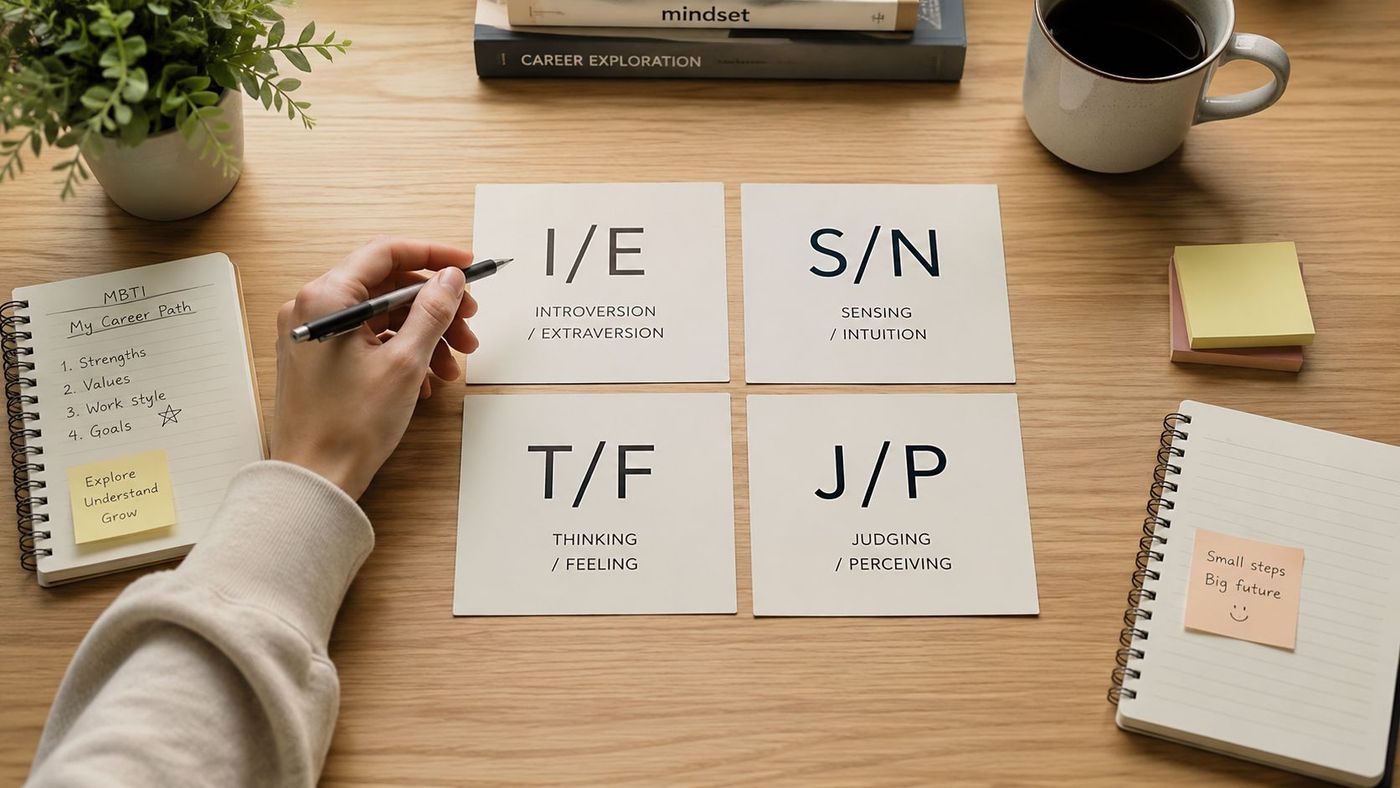
The Myers-Briggs Type Indicator, or MBTI, describes preferences across four paired dimensions: Introversion and Extraversion, Sensing and Intuition, Thinking and Feeling, and Judging and Perceiving. Those preferences combine into type descriptions that can help students discuss how they absorb information, make choices, organise tasks, and interact with others.
A sample report signal might say that a student prefers quiet reflection before speaking, focuses on possibilities rather than immediately observable details, or likes planned study routines. That can open a useful conversation. A student who prefers independent reflection might enjoy a course environment with substantial individual work, while a student who gains energy from discussion may seek collaborative classrooms.
What MBTI can support
MBTI can support self-exploration, communication discussions, and course-environment comparisons. In an Indian school setting, a counsellor might use a student's preference profile to compare the demands of Science, Commerce, Humanities, or a vocational route. The result can also help a family discuss a disagreement, especially when a parent values familiar, concrete pathways and a student is drawn to open-ended or exploratory work.
That interpretation still has limits. MBTI preferences don't measure subject mastery, academic readiness, financial feasibility, or sustained interest in a profession. A type label shouldn't become a reason to exclude a student from Mathematics, Medicine, Law, Design, or any other field.
Practical rule: Use the type description as a conversation starter, then verify it against interests, reasoning evidence, marks, subject experience, and the student's own account.
A student could compare an MBTI report with a broader guide to Google quizzes and personality assessments, but an informal online quiz shouldn't be treated as equivalent to a professionally administered assessment. For Indian students, a counsellor should also ask whether family pressure, coaching routines, or social expectations influenced the answers.
2. Strong Interest Inventory
The Strong Interest Inventory, commonly called SII, focuses on what a student likes, values, and finds engaging. Rather than asking whether a student is already capable of a job, it helps identify patterns across occupational themes, activities, and preferred ways of working. A student may show attraction to investigative tasks, helping roles, business activity, creative expression, or practical work.
A report signal could reveal stronger interest in researching questions than in persuading customers, or greater attraction to organising information than to building physical objects. That distinction matters after Class 10. A student considering Science might be interested in pure scientific inquiry, applied technology, healthcare, or the status associated with the stream. SII-style interpretation can separate those possibilities and guide follow-up questions.
Turning interest into an Indian course decision
SII results should be mapped to real Indian courses and pathways, not left as a list of occupations. A student with strong interest in social research may compare Psychology, Sociology, Economics, Public Policy, or a related liberal arts route. A student attracted to business activity might explore Commerce, management, entrepreneurship, hospitality, or sales-oriented pathways. The result doesn't establish that the student will enjoy every course in that cluster.
Interest is also not the same as aptitude. A student may be fascinated by Engineering but need substantial support in Mathematics. Another may enjoy Biology but feel uncomfortable with clinical environments. The counsellor's job is to examine the gap rather than dismiss either signal.
- Use interests to generate options: Build a shortlist of course families before narrowing colleges.
- Check ability separately: Compare the interest pattern with numerical, verbal, spatial, or subject-specific evidence.
- Discuss family expectations: A visible interest pattern can make a parent-student conversation more specific, but it shouldn't replace practical planning.
- Test practicality: Encourage subject exposure, projects, conversations with practitioners, or introductory learning before making a high-stakes choice.
For Indian students, SII interpretation needs local course knowledge. Occupational language may not map neatly to Indian degrees, entrance exams, or college availability, so human review remains important.
3. Big Five Personality Assessment
The Big Five, also known as the OCEAN model, measures Openness to Experience, Conscientiousness, Extraversion, Agreeableness, and Neuroticism. Unlike a type label, it presents personality as dimensions. A student can therefore show relatively higher or lower tendencies across several traits without being placed into one fixed category.
Consider a report showing strong Conscientiousness and moderate Extraversion. That combination might suggest comfort with planned work and group participation, which could support a structured course involving teamwork. It still doesn't prove that the student will succeed in Engineering, Management, Medicine, or any other field. Academic preparation, motivation, interests, health, teaching quality, and financial circumstances remain separate questions.
Reading traits without turning them into labels
Conscientiousness may prompt a conversation about planning, persistence, and deadline management. Openness may invite exploration of research, creative work, interdisciplinary study, or unfamiliar subjects. Extraversion can inform the preferred learning environment, while Agreeableness may help a counsellor discuss collaboration and conflict. Neuroticism, when measured appropriately, should be handled carefully and supportively. It can indicate sensitivity to stress, not a permanent inability to handle demanding study.
A Big Five report is most useful when it changes an action:
- Higher planning tendencies: Add a demanding study schedule and monitor whether it's sustainable.
- Lower comfort with structure: Test whether external routines, mentoring, or shorter milestones improve follow-through.
- Strong openness: Explore interdisciplinary courses instead of assuming the student must choose a conventional stream.
- Stress sensitivity: Discuss support, workload, sleep, and counselling before treating a competitive pathway as suitable.
StudyHQ describes its own framework as a 26-trait assessment covering cognitive, interest, and behavioural dimensions. Families comparing assessment approaches can review the platform's career guidance resources and ask how a broader profile would be interpreted alongside marks, interests, and counsellor feedback.
The Big Five can add a stable behavioural lens, but it can't predict a student's complete future. A responsible report describes tendencies and practical supports, not fixed career limits.
4. Raven's Progressive Matrices
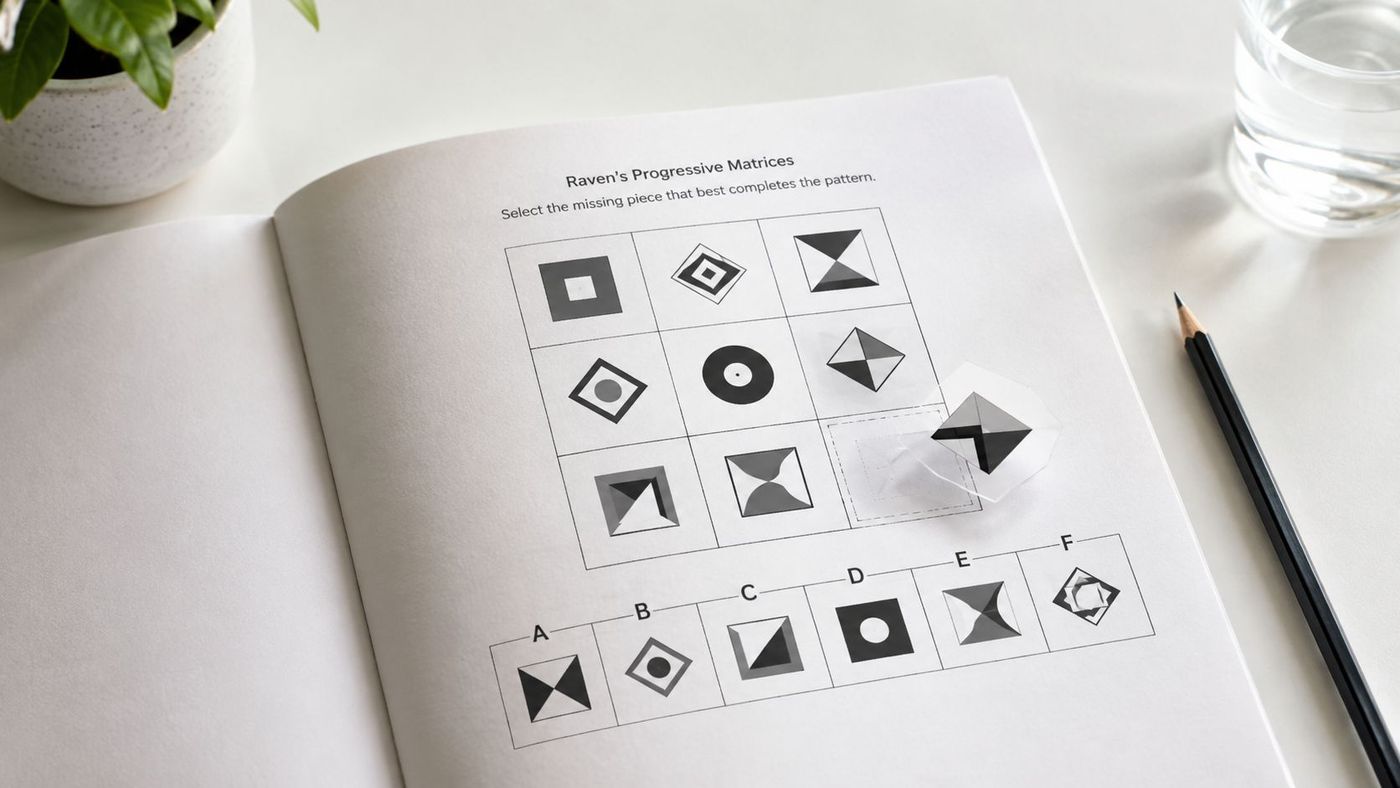
Raven's Progressive Matrices, or RPM, uses visual patterns and missing elements to examine abstract reasoning. Because the task relies less on written language than a verbal test, it can be useful when a counsellor wants evidence about pattern recognition and logical problem-solving without making language proficiency the central factor.
A sample item might show a sequence of shapes changing across rows and columns, with one element missing. The student selects the option that completes the underlying pattern. A strong performance can support the hypothesis that the student handles abstract relationships effectively. It can't establish interest in Science, readiness for JEE, or mastery of school Mathematics.
What the result can and can't settle
RPM may be particularly useful in a diverse Indian school population where students have different language backgrounds and educational opportunities. A counsellor could use the result as one part of a capability profile for a first-generation learner, a student from a rural school, or someone whose verbal performance may not fully reflect reasoning ability.
That doesn't make RPM culture-free in every practical sense. Familiarity with timed testing, digital interfaces, concentration, fatigue, disability access, and previous exposure to puzzles can still affect performance. Administration conditions and professional interpretation matter.
A high abstract-reasoning signal creates an opportunity for further investigation. It doesn't create a Science recommendation by itself.
For a student considering Physics, Mathematics, Computer Science, or Engineering, RPM should be paired with domain-specific evidence. High abstract reasoning with low Science interest may point toward interdisciplinary options, technology-adjacent courses, or a need to understand why the student dislikes current classroom experiences. Moderate reasoning alongside strong interest may suggest foundation support rather than an immediate rejection.
The practical output should be a next step: sample a subject, complete a domain assessment, review school performance, or design a bridging plan. RPM is strongest as a reasoning signal inside a broader decision process.
5. Scholastic Aptitude Test SAT and Similar Reasoning Tests
The SAT and similar standardised reasoning tests examine college-readiness skills through areas such as reading, writing, mathematical reasoning, and problem-solving. For an Indian student planning applications to universities abroad, the score can provide an external benchmark for the relevant admission process. It's also useful as a preparation mirror, showing which kinds of reasoning tasks need more work.
A student may perform strongly in mathematical reasoning but struggle with reading comprehension. That profile supports a more precise plan than a general statement such as “the student is good at academics.” The student might need targeted verbal practice for an international application, while a counsellor separately examines whether the intended course matches the student's interests and working style.
A score is evidence for a pathway, not a personality profile
Standardised reasoning tests can support course validation, but they don't measure curiosity, resilience, ethical judgment, family circumstances, or enjoyment of the subject. High mathematics performance is a useful signal for quantitative readiness. It isn't proof that the student wants Engineering, Economics, Computer Science, or another mathematically demanding route.
For an Indian student, interpretation should also distinguish between test preparation and underlying readiness. Coaching may improve familiarity with format and timing. That can be helpful, but the counsellor should examine practice conditions, independent work, school performance, and the student's actual subject engagement.
Useful questions include:
- Which skill is being measured: Is the weak result numerical, verbal, timing-related, or unfamiliarity with the test format?
- What decision is pending: Is the family choosing a course, preparing an application, or selecting additional support?
- What evidence converges: Do classroom performance, interests, and reasoning results point in the same direction?
- What support is practical: Can the student improve through targeted practice, tutoring, reading, or a different application timeline?
Students preparing for international applications can use StudyHQ's student guidance alongside official university and testing information. A platform can organise decisions, but it shouldn't replace the requirements published by the institution or test provider.
6. Emotional Intelligence Assessments
A student who reads others' emotions well but struggles to regulate their own response under pressure has a specific gap that board-exam season may expose. EQ assessments can surface that mismatch before a high-stakes transition makes it costly.
Tools such as the Mayer-Salovey-Caruso Emotional Intelligence Test and EQ-i do not measure the same evidence. A report should state whether it uses performance-based emotional reasoning, self-report tendencies, or both. A result showing strong recognition of others' emotions alongside weaker self-regulation can guide preparation for board examinations, residential college, group work, and conversations with parents about a demanding course.
Use EQ evidence to plan support
EQ results cannot establish that a student is suitable or unsuitable for Medicine, Law, Management, Nursing, Teaching, or Social Work. Empathy may support people-facing work, while professional performance also requires subject knowledge, boundaries, reasoning, training, and supervised practice. A student who reports stress sensitivity may still succeed in a demanding course if workload planning and support are realistic.
For Indian students, interpretation should account for family expectations, competitive entrance preparation, relocation, financial anxiety, and uncertainty about identity. The assessment can frame a support conversation. It cannot diagnose a mental-health condition or replace a qualified clinician.
A counsellor can translate the result into decisions:
- Stress-management planning: Identify warning signs, recovery routines, and trusted adults before a major transition.
- Communication practice: Prepare a parent-student conversation using specific observations rather than accusations.
- Living and learning preparation: Discuss homesickness, group living, feedback, and help-seeking.
- Referral when needed: Direct serious concerns to an appropriate mental-health professional instead of treating a score as a diagnosis.
EQ evidence becomes more useful when combined with cognitive results, interests, subject performance, and the student's account of daily pressures. A platform such as StudyHQ can organise a broader 26-trait view, but reasoning and counsellor review remain necessary. The practical output is a support plan linked to the student's chosen stream or course, not a fixed label.
7. Career Interest Profiler and RIASEC Model
RIASEC is useful because it measures interest themes, not intelligence, personality, or readiness. Holland's model groups preferences into Realistic, Investigative, Artistic, Social, Enterprising, and Conventional categories. A profiler may report one leading theme or a combination, giving the student a vocabulary for comparing preferred activities with course and work environments.
A sample signal might be repeated preference for investigating how systems operate, building things, or solving practical problems. An Investigative and Realistic pattern could support exploration of Engineering, laboratory work, environmental technology, and related options. It cannot establish Mathematics preparation, study discipline, affordability, or the likelihood of completing a degree.
The profile is most useful when read as a sequence of decisions:
- Interest evidence: Which activities does the student voluntarily choose, sustain, or discuss with curiosity?
- Academic fit: Do subject marks, reasoning results, and learning habits support the demands of the proposed pathway?
- Indian course context: Which degrees, entrance routes, locations, costs, and college environments are realistic for the family?
RIASEC can be introduced before Class 10, while students are exploring rather than selecting a stream. A Social and Enterprising pattern may prompt comparison of Management, Hospitality, Education, Public Relations, and community-oriented options. Artistic and Social interests may point toward Design, Media, Performing Arts, or communication-led courses. Conventional and Artistic preferences can also suggest information design, visual communication, or user experience work.
The code should generate alternatives, not assign an occupation. A counsellor can ask whether the reported preferences reflect genuine activities, limited exposure, family expectations, or familiarity with a particular career label. That distinction matters for Indian students whose choices may be shaped by entrance coaching, relocation limits, and parental priorities.
StudyHQ can organise interest findings alongside a broader 26-trait view, but the platform does not replace reasoning evidence, course research, or counsellor review. The practical result is a shortlist tested against ability, subject performance, and lived constraints. Cognitive, interest, and behavioural evidence should converge before a stream or course recommendation becomes firm.
8. Cognitive Ability Tests for Numerical Verbal Spatial and Logical Reasoning
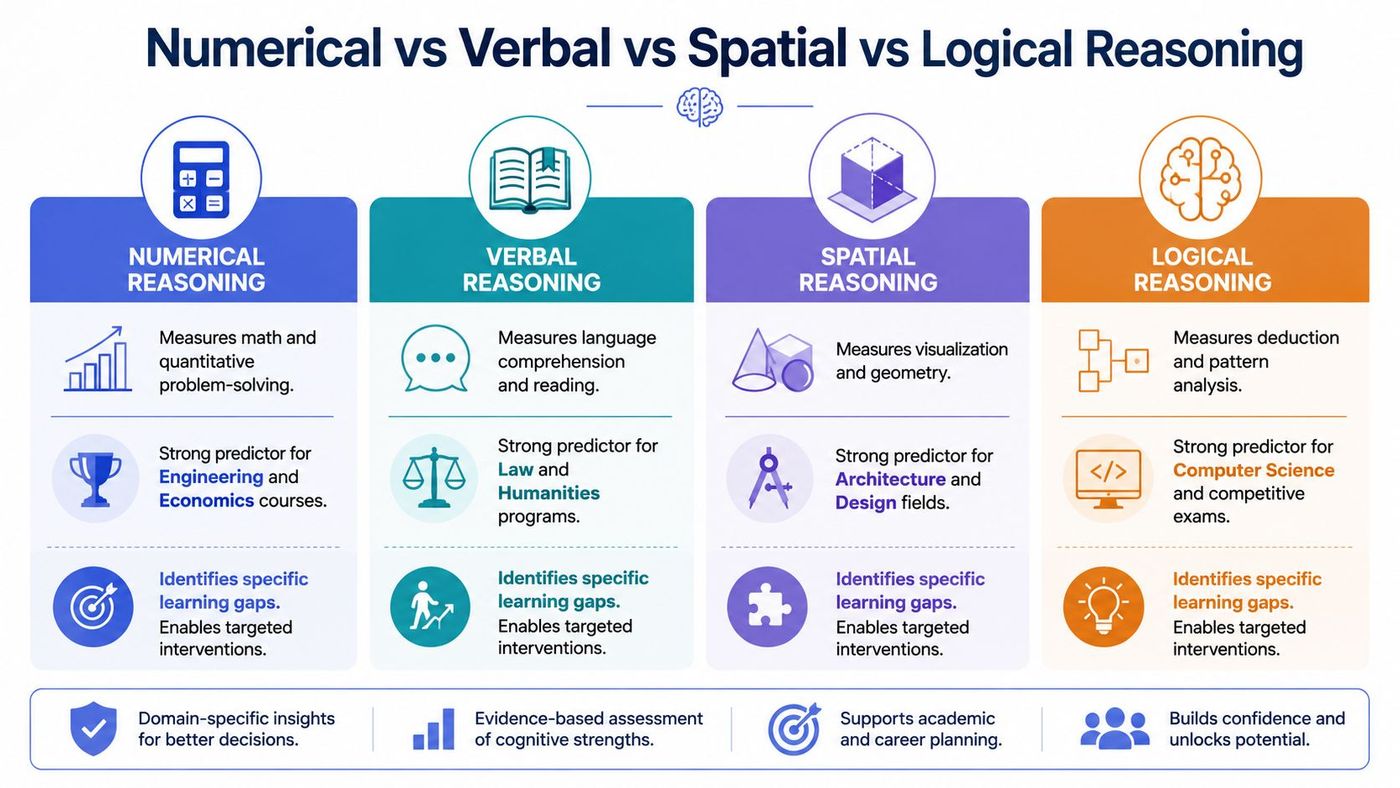
When a student is choosing between Commerce, Humanities, Engineering, or Law, one general reasoning score is rarely enough. Tests that distinguish numerical, verbal, spatial, and logical ability can connect evidence with course demands instead of reducing academic fit to a vague label.
Each domain answers a different question. Numerical items examine quantitative relationships and data handling. Verbal items sample reading comprehension, vocabulary, or argument meaning. Spatial tasks assess visualisation and the manipulation of shapes. Logical items examine deduction, sequences, and pattern analysis. A result describes performance under particular test conditions. It does not prove subject enjoyment, persistence, or future achievement.
Read the pattern, then test the explanation
A student may show strong interest in Computer Science alongside weaker numerical reasoning. That combination supports a targeted review of Mathematics foundations, the specific reasoning gap, available tutoring, and readiness after learning. It does not by itself justify avoiding technology. Interest and measured ability are separate evidence streams.
The reverse pattern also needs care. Strong numerical reasoning with low Mathematics interest should not produce an automatic Commerce or Engineering recommendation. Counselling should examine whether the student prefers applied problems, people-facing work, visual tasks, research, or settings where quantitative work is only one part of the role.
Use the result to frame a decision:
- Commerce: Review numerical reasoning and comfort with data, then test interest in business, markets, or organisation.
- Humanities: Consider verbal reasoning, reading habits, writing demands, and interest in social or cultural questions.
- Engineering or Computer Science: Combine numerical, spatial, and logical evidence with actual Mathematics and Science experience.
- Law or communication-heavy courses: Examine verbal comprehension, sustained reading, argument analysis, and interest in people or institutions.
Indian students also need the score interpreted against subject choices, entrance routes, coaching exposure, and access to learning support. A domain weakness may reflect limited preparation or language familiarity rather than a fixed boundary. Cognitive findings become more useful when compared with interest results, behavioural evidence, school performance, and counsellor review. StudyHQ can organise a broader 26-trait profile, but its output should support that review, not replace it.
Scores are snapshots, not identity statements. Families using a digital platform should review its data practices and StudyHQ's security information before sharing sensitive student information.
8 Psychometric Assessments: Side-by-Side Comparison
| Assessment | 🔄 Implementation complexity | ⚡ Resource & time requirements | ⭐ Expected outcomes / validity | 📊 Ideal use cases | 💡 Key advantages / practical tip |
|---|---|---|---|---|---|
| Myers-Briggs Type Indicator (MBTI) | 🔄 Low, simple self-report format | ⚡ Low, ~15–20 min, low cost, minimal facilitation | ⭐⭐, useful for communication/team fit; lower test-retest reliability | 📊 Initial self-exploration, team dynamics, broad career exploration | 💡 Accessible and memorable; use as a starter tool and combine with aptitude tests |
| Strong Interest Inventory (SII) | 🔄 Moderate, long survey + expert interpretation | ⚡ Medium–High, 30–45 min, licensed/costly, counselor-led interpretation | ⭐⭐⭐⭐, strong predictive validity for career satisfaction and occupational fit | 📊 Vocational exploration, stream/course validation, detailed occupational matching | 💡 Provides concrete job links; best after aptitude screening to narrow options |
| Big Five (OCEAN) | 🔄 Moderate, multiple validated versions, requires nuanced interpretation | ⚡ Low–Medium, short forms available; some scoring expertise required | ⭐⭐⭐⭐, high reliability and predictive validity for academic/job outcomes | 📊 Comprehensive student profiling, predicting performance and long-term fit | 💡 Scientific foundation; use continuous scores and combine with interests/aptitude |
| Raven's Progressive Matrices (RPM) | 🔄 Low–Moderate, standardized non-verbal administration | ⚡ Low–Medium, ~30–45 min, objective scoring, minimal language bias | ⭐⭐⭐, strong predictor of abstract reasoning and STEM aptitude | 📊 Culture-fair cognitive screening, identifying gifted students and STEM potential | 💡 Language-independent and equitable; include in multi-test batteries for context |
| SAT & similar standardized reasoning tests | 🔄 Moderate, timed, proctored exam conditions | ⚡ Medium–High, significant prep/coaching costs; proctored sessions | ⭐⭐⭐, strong benchmark for quantitative readiness; coaching can affect scores | 📊 College admissions, benchmarking STEM readiness, study-abroad planning | 💡 Provides comparable external benchmark; combine with interest/trait data for fit |
| Emotional Intelligence (EQ/EI) assessments | 🔄 Moderate, ability or self-report formats, interpretive nuance | ⚡ Medium, 30–130 items; some versions need trained interpretation | ⭐⭐, predictive for resilience, teamwork; less for course-specific success | 📊 Assessing readiness for high-stress transitions, counselling and soft-skill development | 💡 Highlights need for support and conflict mediation; useful for parent-student dynamics |
| Career Interest Profiler / RIASEC | 🔄 Low, intuitive, action-oriented framework | ⚡ Low, ~15–30 min, scalable and cost-effective | ⭐⭐⭐, reliable for mapping interests to occupations and courses | 📊 Early career exploration, stream selection, mapping to educational paths | 💡 Clear occupational mapping; use early and pair with aptitude validation |
| Domain-specific Cognitive Ability Tests | 🔄 Moderate, multiple domain modules and scoring | ⚡ Low–Medium, 15–45 min per domain; scalable but needs interpretation | ⭐⭐⭐⭐, highly predictive for domain-specific course success (numerical, spatial, verbal) | 📊 Stream/course placement, identifying learning gaps, targeted interventions | 💡 Granular aptitude insights; align domain scores with course prerequisites and support plans |
Turn Assessment Scores Into Better Decisions
The strongest interpretation starts with the student's question, not the test catalogue. “Should I choose Science after Class 10?” requires different evidence from “Is this course right for me?” or “Am I ready to apply abroad?” Once the question is clear, review cognitive evidence, test interest alignment, examine behavioural and emotional context, and then check practical realities such as course availability, budget, location, entrance requirements, and pathway length.
India's public-school experience shows why scale and interpretation must be considered together. A Ministry of Education STARS presentation reports that 80% of students completed psychometric assessments, with participation across Classes 9 to 12 and nearly balanced gender participation at 49% male and 51% female. The material supports a useful conclusion: psychometric assessment is being deployed beyond small experimental settings, but wider reach increases the need for careful reporting, culturally fair administration, and counsellor review. The STARS presentation from the Ministry of Education provides that government-linked context.
Evidence quality also matters. An Indian validation study of the Academic Self Concept Scale used 581 CBSE students and reported an 8-factor structure, alongside fit and consistency metrics including GFI = 0.99, CFI = 0.92, TLI = 0.89, RMSEA = 0.1173, SRMR = 0.0445, and Cronbach's alpha = 0.918. Those results support discussion of how a particular scale performs in an Indian school population, but they don't validate every assessment or turn self-concept into a direct career prediction. Review the Academic Self Concept Scale validation study when evaluating evidence.
A disciplined way to read any report
Use this short sequence before acting on a result:
- Identify the construct: Is the assessment measuring reasoning, interest, personality, emotional functioning, or academic self-concept?
- Read the scale correctly: Note whether the report gives a score, percentile, preference, profile, or descriptive band.
- Ask what it excludes: A reasoning score may not measure motivation. An interest score may not measure preparation. A personality result may not measure skill.
- Look for convergence: Give more weight when cognitive, interest, behavioural, school, and conversation evidence point in a similar direction.
- Convert mismatch into action: Use a weak area to plan support, exposure, tutoring, or further assessment rather than attaching a permanent label.
- Review context: Check language, fatigue, coaching exposure, disability access, family pressure, and the conditions under which the student responded.
A multicentric Indian screening study illustrates the value of matching the assessment design to the decision. It reported 43.3% of students with moderate stress, 13.3% with severe psychiatric symptoms, 29.2% referred to counselling, and 20% referred to psychiatry. The study also found close agreement between a shorter two-test battery and a six-test version, with no significant referral difference, and reported agreement values of k = 0.70 for stress and k = 0.68 for psychiatric symptoms against clinical evaluation. These findings concern screening and triage, not stream choice or career prediction. The Indian digital student-screening study shows why a shorter workflow may be useful in large settings when qualified professionals interpret the results.
StudyHQ is one possible India-focused workflow. Its 26-trait assessment brings cognitive, interest, and behavioural dimensions together, while Bixa maps profiles to 178 course specialisations and generates recommendations and roadmaps. A report can be more useful when it documents why a course was suggested, what risks or mismatches require attention, and which questions a certified counsellor should discuss with the family. That reasoning should still be checked against the student's subjects, marks, preferences, access, budget, and goals. Families can also compare structured student guidance approaches with broader AI recruitment guidance while remembering that school and career decisions require a different standard of human context.
StudyHQ combines a 26-trait assessment, course mapping across 178 specialisations, personalised roadmaps, and certified counsellor support for Indian students and families. Visit StudyHQ to turn psychometric signals into a documented conversation about streams, courses, colleges, and next steps.